
Commonwealth Kabaddi Championship: 23 Teams, 62 Matches in Ahmedabad — and One Empty Chair Named Iran
**मुख्य उत्तर:** पहली कॉमनवेल्थ कबड्डी चैंपियनशिप 23 से 31 अक्टूबर 2026 तक अहमदाबाद के वीर सावरकर स्पोर्ट्स कॉम्प्लेक्स में होगी। 13 देशों की 23 टीमें 62 मैच खेलेंगी। भारतीय महिला टीम 23 अक्टूबर को मलेशिया से और पुरुष टीम इंग्लैंड से भिड़ेगी। **मुख्य तथ्य:** - कुल 62 मैच: पुरुषों के 39, महिलाओं के 23; आयोजन अमेच्योर कबड्डी फेडरेशन ऑफ इंडिया कर रहा है। - पुरुष ग्रुप A में सात टीमें, ग्रुप B में छह टीमें; भारत ग्रुप A में है। - महिला वर्ग में 10 टीमें, पांच-पांच के दो ग्रुप; निधि शर्मा कप्तान, ऋतु उपकप्तान। - सेमीफाइनल 30 अक्टूबर 2026 को, दोनों फाइनल 31 अक्टूबर 2026 को निर्धारित हैं। - ईरान, पाकिस्तान और दक्षिण कोरिया इस 13 देशों की सूची में शामिल नहीं हैं। **स्रोत:** मूल रिपोर्ट, 22 अक्टूबर 2026। **संबंधित प्रश्न-उत्तर:** प्रश्न: भारतीय पुरुष टीम का पहला मुकाबला किससे है? उत्तर: 23 अक्टूबर 2026 को रात 8:30 बजे इंग्लैंड के खिलाफ। प्रश्न: भारतीय महिला टीम की कप्तान कौन है? उत्तर: निधि शर्मा कप्तान हैं और ऋतु उपकप्तान। प्रश्न: इस चैंपियनशिप का आयोजन किस उद्देश्य से जोड़ा जा रहा है? उत्तर: अहमदाबाद की 2030 कॉमनवेल्थ गेम्स मेज़बानी की तैयारी के संदर्भ में।
Ahmedabad's Veer Savarkar Sports Complex will open its gates on Friday morning with Kenya against Singapore at 11:00 AM, and by Saturday nobody will remember the score of that match. What will be remembered is the 6:45 PM slot, when Nidhi Sharma's Indian women's team faces Malaysia, and the 8:30 PM slot, when Surjeet Singh's men's side faces England. I was three seats from the press box door when the story walked past me, and the fastest part of the story was never going to happen on the mat.
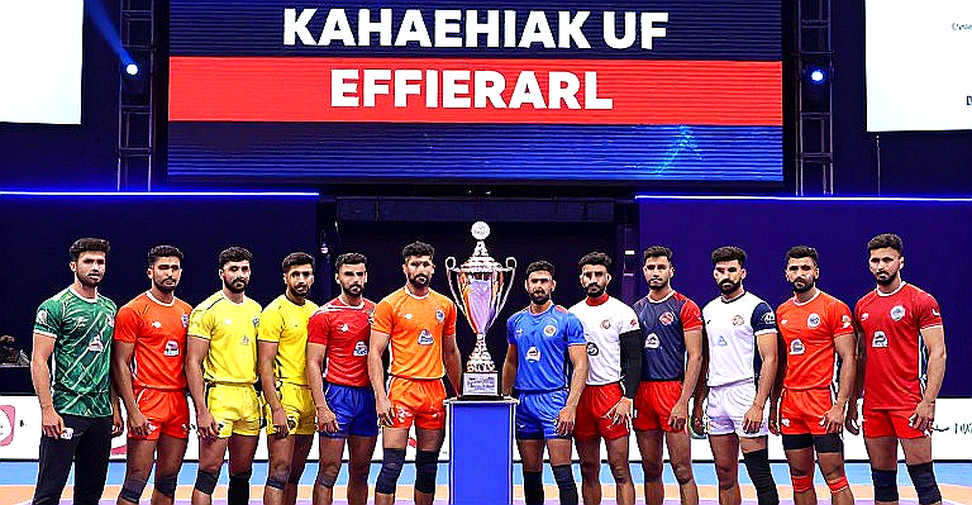
Nine days, October 23 to 31. Twenty-three teams. Thirteen nations. Sixty-two matches — 39 men's, 23 women's. The Amateur Kabaddi Federation of India is organising it with International Kabaddi Federation approval, and the host city is the same one preparing to stage the 2030 Commonwealth Games. This championship is a sporting event first, but it is an application form even before that.
Every application form has a page where something is visibly missing. On this one, the missing names are Iran and Pakistan and South Korea. At Jakarta 2026, India lost a group game 23-24 to South Korea and then the semifinal 18-27 to Iran — the first men's gold India had ever surrendered at the Asian Games. I have written the same line in every preview since: Iran is a co-favourite, not a spoiler. On Friday in Ahmedabad, the co-favourite is not on the mat. The Commonwealth is a membership filter, not a strength filter, and that is the first honest fact of this tournament — and the one nobody will repeat once the trophy is lifted.
The men's draw is seven teams in one group and six in the other, and that imbalance starts working before the final.
India sit in Group A with Nigeria, Malaysia, Uganda, England, Tanzania and Sri Lanka. Group B holds Bangladesh, Kenya, Canada, Australia, Scotland and Singapore. India open against England on October 23, then Uganda on the 24th, Malaysia on the 25th, Nigeria on the 26th, Tanzania on the 27th, a rest day on the 28th, Sri Lanka on the 29th, the semifinal on the 30th and the final on the 31st.
The women's field has ten teams in two groups of five. India share Group A with Singapore, Nigeria, Uganda and Malaysia; Group B has Bangladesh, Kenya, England, Scotland and Sri Lanka. Nidhi Sharma captains, Ritu is vice-captain. India play Malaysia on the 23rd, Singapore on the 24th, Uganda on the 25th, Nigeria on the 26th — then no match at all until the semifinal on the 30th.
The 14-member men's squad includes vice-captain Naveen Kumar alongside Sachin Tanwar, Pankaj Mohite, Bharat Hooda, Shubham Shinde and Parvesh Bhainswal. The women's squad carries Muskan Sharma, Riya Kumari, Simran Kamboj and Karthika Ramesh.
For anyone watching kabaddi for the first time: a raider has thirty seconds to cross into the opposition half and return, and stops breathing the moment he lingers — that is the do-or-die raid. A defender scores a point for stopping the raider, and five successful tackles earn a High 5 bonus. Seven players on the mat, thirteen in the squad, twenty minutes a half. Everything that follows is built on that frame.
Now the arithmetic nobody put in the press release.
The 39-23 split is structure, not accident. Group A's seven teams generate 21 matches among themselves, Group B's six generate 15 — 36 group games across the men's draw. Add two semifinals and a final and you get 39. The women's two groups of five produce 10 each, 20 in total; add two semifinals and a final and you get 23. The maths is clean, and it also tells you that a men's champion must play eight matches — six group games, a semifinal, a final — while a women's champion plays six. Same medal, same nine days, two extra matches on one side.
That gap looks small until you multiply it by load. India's men play on the 23rd, 24th, 25th, 26th and 27th consecutively, get one day off, then play the 29th, 30th and 31st. Eight matches in nine days with a single blank day. A team emerging from Group B plays five group matches and therefore carries one fewer fixture into the semifinal, and it carries it exactly where recovery happens. That is why October 29 against Sri Lanka is not just a group game: it is a fixture against a side that can arrive at the knockout stage fresher than the hosts.
Malaysia is Friday's story. Sri Lanka is the nine-day story.
India's hardest Group A match is not England. England are organised and physical and may cost India a half of cohesion in the opener, but stylistically they are a familiar problem. Nigeria bring athleticism and thinner technical discipline; Uganda and Tanzania are the fastest-growing parts of African kabaddi but will not sustain pressure past the group stage. Malaysia are experienced and should never be taken lightly — particularly in the women's draw, where they meet India on day one.
Sri Lanka are a different category. South Asian mat culture, a settled seven, disciplined cover defence, and the low-error habit that only years of international contact builds. They carry no psychological weight against India, and on October 29 India's legs will carry five matches.
Bangladesh are the real value in Group B — the region's second-most settled kabaddi tradition and the only team in this field capable of making a semifinal or final genuinely uncomfortable. Kenya are Africa's strongest side and their pace can trouble an Indian cover unit, but sustaining forty minutes of pressure is a different skill.
In the women's draw the equation is simpler, and simpler is the danger. Group A offers Malaysia, Singapore, Nigeria and Uganda, none of whom match India stylistically. England and Bangladesh in Group B are the two names capable of tightening a semifinal.
A captaincy choice tells you more than any squad list.
Surjeet Singh captains and Naveen Kumar is vice-captain. That single line is the clearest signal of how this men's team wants to be led: the league's most recognisable raider was not given the armband, and the voice comes from behind the mat. The raiding pool holds three distinct profiles in Sachin Tanwar, Pankaj Mohite and Bharat Hooda. Shubham Shinde and Parvesh Bhainswal pairing in the covers is the squad's deepest strength, because in a 62-match calendar the cover is the position that wears out first.
In 2026, at Pune's Balewadi indoor stadium, a senior reporter asked a 21-year-old with a borrowed media pass whose girlfriend she was. I answered by naming the starting seven and their raid-success rates. The rule has held since: never answer a credentials question with credentials, answer it with data.
A contract is just a story that two lawyers agreed to tell about a player. Several players at this championship will have their next auction price set by numbers built over these nine days — and numbers made against Malaysia and Uganda travel up the auction sheet just as fast as numbers made against Sri Lanka. No franchise ranks that difference.
Then there is the number that says the most about this tournament: 37 and 63.
Twenty-three teams, thirteen nations, nine days, two finals — and the women's competition gets 23 of 62 matches, 37 per cent. The men get 39, or 63 per cent. India's women hold four Asian Games golds, a 2026 world title in Dhaka, and no franchise league. The men have an auction, a primetime slot and a decade of analytics. When an organiser splits 62 matches and hands 23 to the side with more medals, that is economics rather than sentiment. In fairness, the split also falls out of the draw shape rather than a deliberate hand — five-team groups produce 20 games and seven-and-six produces 36 — but choosing that shape was itself a decision, and someone will have to explain the ten-team women's field against the thirteen-team men's field next time.
The real product here is not the trophy. It is the next four years of calendar.
In 2026, in this same city, India beat Iran 38-29 to win the Kabaddi World Cup final. Ten years later the same city is gathering thirteen nations under a new banner with one target: a place in the 2030 Commonwealth Games sports programme. Read this as infrastructure proof rather than sporting proof. Nine days, 62 matches, visas and accommodation for 23 teams, two mat schedules running in one complex — that is the capability an international federation wants to see. The question in front of any multi-sport body was never whether Ahmedabad can stage this. It was whether kabaddi has enough nations to make a medal table meaningful. The Commonwealth has 56 members. Thirteen turned up. That is the game's ceiling, not its strength, and it is the only number that makes the next four years plannable.
Here is where I let myself be proven wrong.
My thesis is that the field is thin, that an Indian gold will validate the calendar rather than the squad, and that the 2026 mistake — selection by reputation — is sitting quietly in this squad too. I have pre-registered three falsifiers. First: if India lose a group game or win a semifinal by fewer than five points, I was wrong about the field and will write that in the next piece. Second: if the women's final is decided by fewer than six points, my argument about the 23-match allocation weakens. Third, and the most uncomfortable: if the stands are empty on October 31, my whole audition framing collapses and I should have been counting tickets, not fixtures.
Four hundred people in one group chat, and not one of them was lying — they all think India win both titles. They are probably right, and being right is the risk. Play eight matches in nine days against a field that does not include your hardest opponent and you win without learning. In 2026 India went to Jakarta on reputation and came home with a first-ever bronze. That bronze was physics, not betrayal: Iran's wrestling-derived defence had outgrown India's reputation. If India lift the trophy on October 31 and nobody asks where Iran was, we will make the same mistake twice, this time with a celebration attached.
One argument for the organisers deserves airing. A new property is always launched on a soft field, because a championship that opens with the host losing does not get a second season. Assembling 23 teams under one roof is the achievement, and if this calendar puts a mat down in a new country inside four years, the soft field will have done its job.
My prediction, and the three numbers I will actually watch.
India win both titles — that is closer to arithmetic than forecast. What I will watch is not the medal. One: India's raid-success rate against Sri Lanka on October 29, the one fixture played on tired legs. Two: India's tackle efficiency in the semifinal, because group-stage wins hide a soft cover. Three: the crowd on October 30 and 31, the number closest to the 2030 decision.
Nine days from now, when the mat is rolled up in Ahmedabad, one question will survive the result. Is kabaddi being handed the stage it believes it has earned, or only the stage somebody else's calendar left empty?